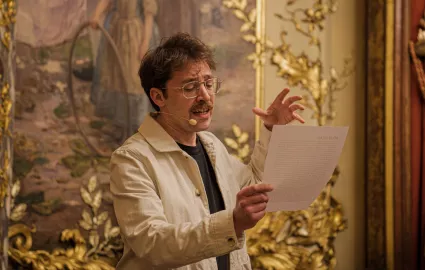
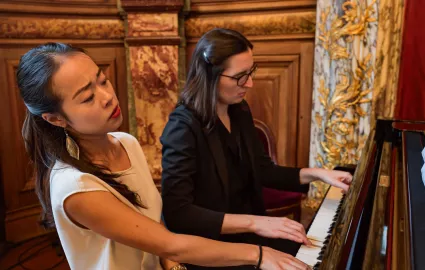
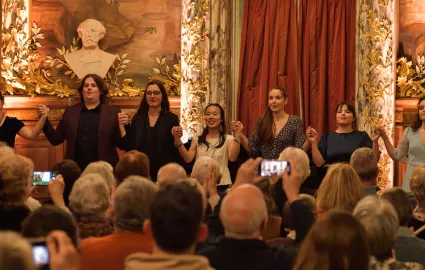
Let yourself be swept away by the promising voices of the Académie’s artists through a musical journey where each season unveils its own recital. A celebration of the Opéra-Comique’s repertoire and of its past and present composers, brimming with charm and passion.
Cast
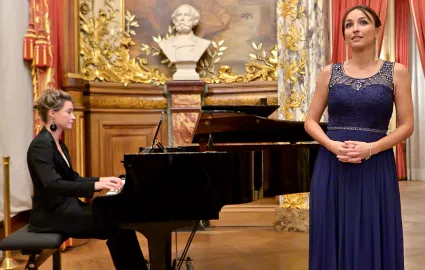
With the artists of the Académie of the Opéra-Comique: Thaïs Raï-Westphal, soprano • Flore Royer, mezzo-soprano • Paul-Louis Barlet and Félix Merle, baritones • Flore-Élise Capelier and Ayano Kamei, choir directors, pianists
Mathieu Pordoy, directeur des études musicales
See all the castProgram
With the artists of the Académie of the Opéra-Comique : Déborah Salazar and Thaïs Raï-Westphal, sopranos • Flore Royer, mezzo-soprano • Paul-Louis Barlet and Félix Merle, baritones • Ayano Kamei and Flore-Élise Capelier, choir directors, pianists
Mathieu Pordoy, director of music studies
Program
1900-1902 at the Opéra-Comique / Around the creation of Pelléas et Mélisande
In April 1902, Debussy's Pelléas et Mélisande – his only opera – premiered, marking a revolution in French lyric art and an aesthetic turning point at the Opéra-Comique.
Welcomed by the Bibliothèque nationale de France, the Académie artists have explored works created shortly before this event, often by the same artists. They bring back to life the effervescence of this period, between tradition and modernity.
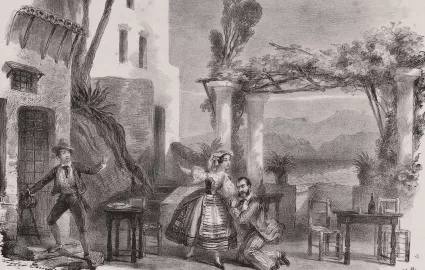
- « Quel tracas pour une servante », Mariette's aria from La Chambre bleue by Jules Bouval, libretto by Antony Mars and Édouard Noël, premiered in 1902 at the Opéra-Comique
Mariette: Thaïs Raï-Westphal
- « À Nancy, j'avais pris ma place », Duval's aria from La Sœur de Jocrisse by Antoine Banès, libretto by Albert Vanloo, premiered in 1901 at the Opéra-Comique
Duval: Paul-Louis Barlet
- « Quand les chats n'y sont pas », duet of Fiamina and Le Diable from Grisélidis by Jules Massenet, libretto by Armand Silvestre and Eugène Morand, premiered in 1901 at the Opéra-Comique
Fiamina: Flore Royer
Le Diable: Félix Merle
- « Depuis le jour », Louise's aria from Louise by Gustave Charpentier, libretto by Gustave Charpentier and Saint-Paul-Roux, premiered in 1900 at the Opéra-Comique
Louise: Déborah Salazar
- Pelléas et Mélisande, excerpts by Claude Debussy, text by Maurice Maeterlinck, premiered in 1902 at the Opéra-Comique
Pelléas: Paul-Louis Barlet
Golaud: Félix Merle
Mélisande: Déborah Salazar / Thaïs Raï-Westphal / Flore Royer
Geneviève: Flore Royer
The programme is provided for information purposes only and may be subject to last-minute changes.
Chabrier : A Portrait
With the artists of the Académie of the Opéra-Comique: Thaïs Raï-Westphal, soprano • Flore Royer, mezzo-soprano • Paul-Louis Barlet and Félix Merle, baritones • Flore-Élise Capelier and Ayano Kamei, choir directors, pianists
Program
Emmanuel Chabrier
- España, piano à quatre mains
Avec Ayano Kamei, cheffe de chant, pianiste • Flore-Élise Capelier, cheffe de chant, pianiste
- Chansons pour Jeanne, mélodie (poème de Catulle Mendès)
Avec Félix Merle, baryton
- Chanson tzigane (« Il est un vieux chant de Bohème »), extraite de Le Roi malgré lui
Avec Thaïs Raï-Westphal, soprano
- Trio de l’enlèvement (« Maintenant il faut partir vite »), extrait de L’Étoile
Avec Thaïs Raï-Westphal, soprano • Flore Royer, mezzo-soprano • Paul-Louis Barlet, baryton
- Pastorale des cochons roses, mélodie (poème d’Edmond Rostand)
Avec Paul-Louis Barlet, baryton
- La mort de Thanasto, grande scène, extrait de Briséis
Avec Flore Royer, mezzo-soprano • Thaïs Raï-Westphal, soprano • Félix Merle, baryton
- Souvenirs de Munich, fantaisie à quatre mains en forme de quadrille sur des thèmes de Tristan et Isolde de Wagner
Avec Ayano Kamei, cheffe de chant, pianiste • Flore-Élise Capelier, cheffe de chant, pianiste
- Nocturne, extrait de Le Roi malgré lui
Avec Thaïs Raï-Westphal, soprano • Flore Royer, mezzo-soprano
- « Ce vin généreux », extrait de Une Éducation manquée
Avec Félix Merle, baryton
- Final de l’acte I, extrait de Le Roi malgré lui
Avec Thaïs Raï-Westphal, soprano • Flore Royer, mezzo-soprano • Paul-Louis Barlet, baryton • Félix Merle, baryton
The schedule is subject to change and may be modified at the last minute.
With the artists of the Académie of the Opéra-Comique : Déborah Salazar, soprano • Flore Royer, mezzo-soprano • Paul-Louis Barlet, Félix Merle, baritones • Ayano Kamei and Flore-Élise Capelier, choir directors, pianists
Mathieu Pordoy, director of music studies
Program
Christoph Willibald Gluck
Iphigénie en Aulide
- Ouverture (Ayano Kamei / Flore-Élise Capelier)
- « Diane impitoyable », air d’Agamemnon (Félix Merle / Ayano Kamei)
- « Dieux puissants que j’atteste », air de Clytemnestre (Flore Royer / Ayano Kamei)
Iphigénie en Tauride
- « Oh Malheureuse Iphigénie », air d’Iphigénie (Déborah Salazar / Ayano Kamei)
Jacques Offenbach
Les Contes d'Hoffmann
- Suite n°1 à quatre mains d’après Les Contes d’Hoffmann par Renaud de Vilbac (Ayano Kamei / Flore-Élise Capelier)
- « Dans les rôles d’amoureux langoureux », couplets de Lindorf (Félix Merle / Flore-Élise Capelier)
- « Elle a fui, la tourterelle », air d’Antonia (Déborah Salazar / Flore-Élise Capelier)
- « Vois, sous l’archet frémissant », air de Nicklause (Flore Royer / Flore-Élise Capelier)
La Jolie Parfumeuse
- « Pardieu, c'est une aimable charge », air de Germain (Paul-Louis Barlet)
Robert Planquette
Les Cloches de Corneville
- « Dans ma mystérieuse histoire », rondeau de Serpolette (Flore Royer / Ayano Kamei)
- « J’ai fait trois fois le tour du monde », rondeau-valse de Henri (Paul-Louis Barlet / Ayano Kamei)
André Messager
- « Quand vous tournez vers moi les yeux », duo Isoline - Isolin, extrait d'Isoline (Déborah Salazar / Flore Royer / Ayano Kamei)
- « Cinquante ans, c'est l'âge admirable », duo Lebardin - Pagenet, extrait de La Petite Fonctionnaire (Paul-Louis Barlet / Félix Merle / Ayano Kamei)
- « Deci delà, cahin caha », duo de l'âne, Véronique (Paul-Louis Barlet / Déborah Salazar)
- « Mon avis est qu'il faut être pratique », terzetto de Miss Dollar (Tutti)
With artists from the Académie de l'Opéra-Comique: Déborah Salazar, Thaïs Raï-Westphal, sopranos • Flore Royer, mezzo-soprano • Paul-Louis Barlet, Félix Merle, baritones • Flore-Élise Capelier, vocal coach, pianist
Mathieu Pordoy, Director of Music Studies
Program
Vincenzo Bellini
- Ouverture, Il pirata (Milan, 1827)
Avec Flore-Élise Capelier, cheffe de chant, pianiste
- « Dopo l’oscuro nembo » Romance de Nelly, Adelson e Salvini (Naples, 1825)
Avec Flore Royer, mezzo-soprano
Gioacchino Rossini
- « Sventurata » air de Clorinda, La Cenerentola(Rome, 1817)
Avec Thaïs Raï-Westphal, soprano
- « Come un’ape » air de dandini, La Cenerentola(Rome, 1817)
Avec Félix Merle, baryton
- « Je rends à votre amour » Trio Mathilde – Jemmy – Hedwige, Guillaume Tell(Paris, 1829)
Avec Déborah Salazar, soprano, Thaïs Raï-Westphal, soprano, Flore Royer, mezzo-soprano
- « Dans ce lieu solitaire » air de Raimbaud, Le comte Ory (Paris, 1828)
Avec Paul-Louis Barlet, baryton
Gaetano Donizetti
- « La voilà… mordieu qu’elle est gentille » duo Sulpice, Marie, La fille du régiment (Paris, 1840)
Avec Thaïs Raï-Westphal, soprano, Félix Merle, baryton
Gioacchino Rossini
- « Bel raggio lusinghier » Cavatine de Semiramide, Semiramide (Venise, 1823)
Avec Déborah Salazar, soprano
Vincenzo Bellini
- « Il rival salvar tu dei » duo Riccardo, Giorgio, I puritani(Paris, 1835)
Avec Paul-Louis Barlet, Félix Merle, barytons
The Academy of the Opéra-Comique
A major player in operatic creation, the Opéra-Comique has launched its new Académie in 2023. Aimed at new generations of performers, the Académie de l'Opéra-Comique is designed to promote the comic opera genre and its specific art of interpretation, as close as possible to the texts and the stage, among young talent.
As a centre of artistic excellence in French singing and the art of the spoken and sung word, it nurtures the artistic vitality of the Opéra-Comique's opera season by promoting the values of fairness, diversity and inclusion that the theatre stands for. The Académie also aims to develop new ways of looking at opera and to encourage the emergence of new artistic formats through creative residencies and the continuous presence of 12 young artists throughout the opera season.
Distribution