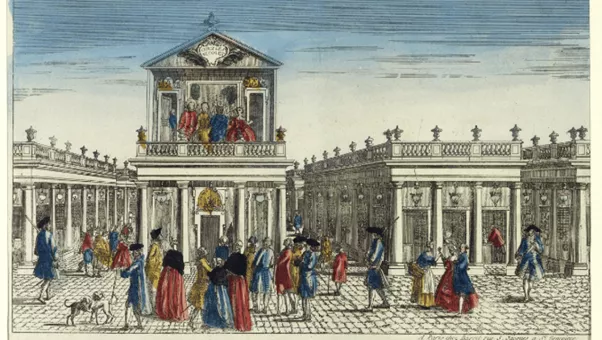
Foire Saint-Germain, vers 1700, © BNF
The birth of a genre
At the start of the 18th century, two major seasonal fairs animated Paris: the Saint-Germain Fair on the Left Bank and the Saint-Laurent Fair on the Right Bank. It is within this context that the opéra-comique took shape. The word « comique » does not mean that laughter is compulsory: it refers to a performance in which sung passages are woven into spoken theatre. The opéra-comique thus stands in contrast to opera, which is sung throughout.
Founded by Catherine Vondrebeck in 1714, the Opéra-Comique troupe gained official status under Louis XV in 1762. It is at this time that the genre found its canonical form, notably with Charles-Simon and Justine Favart. He wrote librettos; she contributed to the invention of stage costume and acting. In 1780, their name was given to the street on which the new theatre was built: this is where the name Salle Favart comes from.
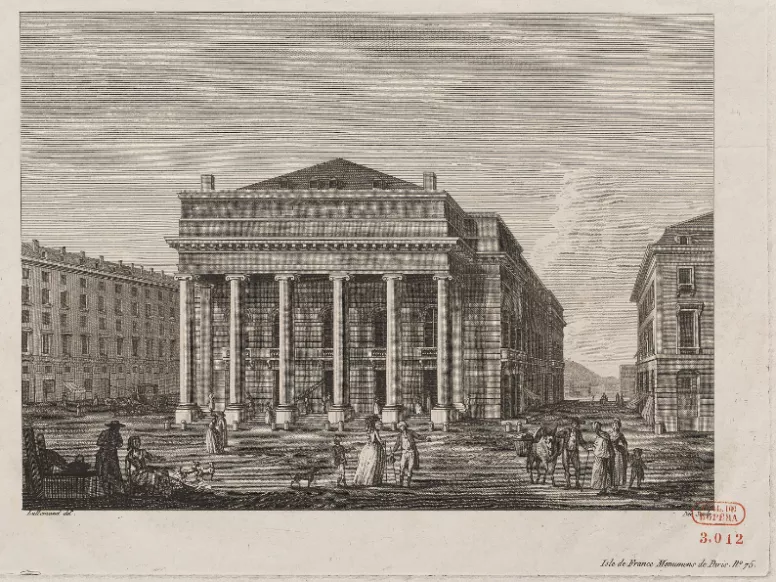
Première Salle Favart © BNF
A house of creation
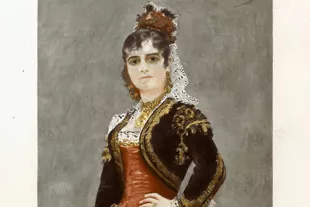
The Opéra-Comique is one of the oldest theatrical and musical institutions in France. Its history is bound up with the birth and circulation of a repertoire that is exported, translated and adapted across European stages. Over the centuries, the house has given birth to many works that have shaped the lyrical canon: La Fille du régiment by Donizetti, La Damnation de Faust by Berlioz, Carmen by Georges Bizet, The Tales of Hoffmann by Jacques Offenbach, Manon by Jules Massenet, Lakmé by Léo Delibes, Pelléas et Mélisande by Claude Debussy, L’Heure espagnole by Ravel and La Voix humaine by Poulenc.
The Opéra-Comique repertoire counts some 3,000 titles created since 1715. It carries a tradition of comedy in music, attentive to the societies, conditions, ages of life, ambitions and sensibilities of each era.
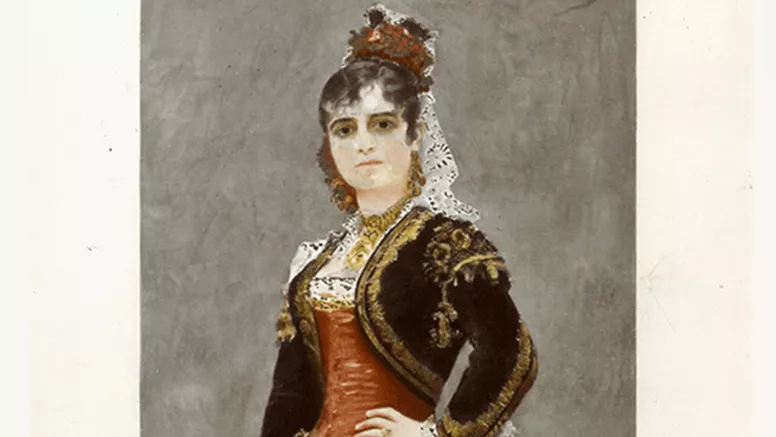
Costume de Carmen © BNF
The Salle Favart
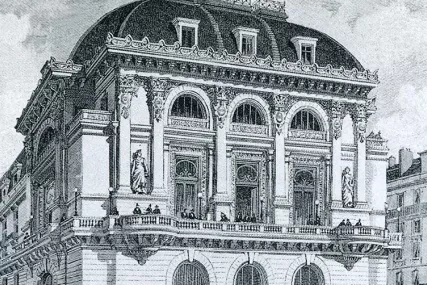
After the 1887 fire, the Opéra-Comique was rebuilt on the same plot of land, offered in 1780 by the Duke of Choiseul.
The third Salle Favart was inaugurated in 1898. It continues to turn its back on the boulevards which, once the northern boundary of Paris, had by then become a cultural artery.
Selected by a jury chaired by Charles Garnier, architect Louis Bernier’s project combined the dimensions and heritage of the site, the decorative craftsmanship of the late 19th century and the modern technical requirements of the time: a structure in puddled iron (like the Eiffel Tower) and inventive use of electricity.
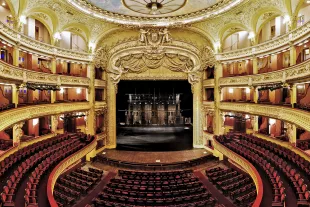
Renovated in 2016, the Salle Favart has 1,200 seats. Decked in red and gold, this so-called « French-style » house is designed for perfect visual communication within the auditorium and between the stage and the audience. Its unrivalled acoustics, which inspired Debussy, Ravel, Poulenc and many others, remain the living heart of the Opéra-Comique.
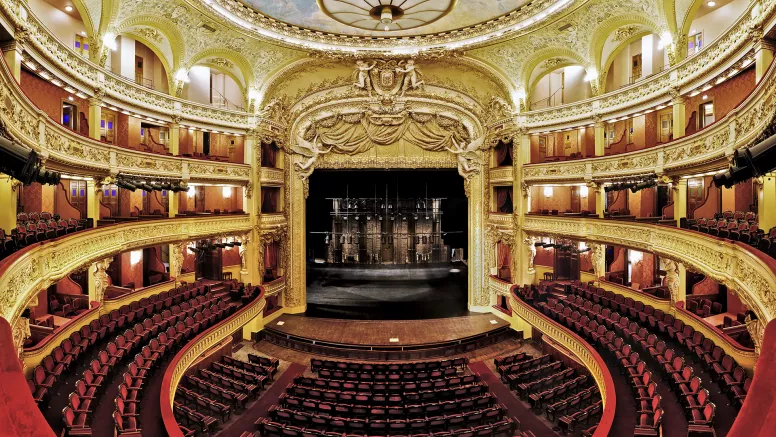
Salle Favart - Opéra-Comique © Stefan Brion
A listed setting
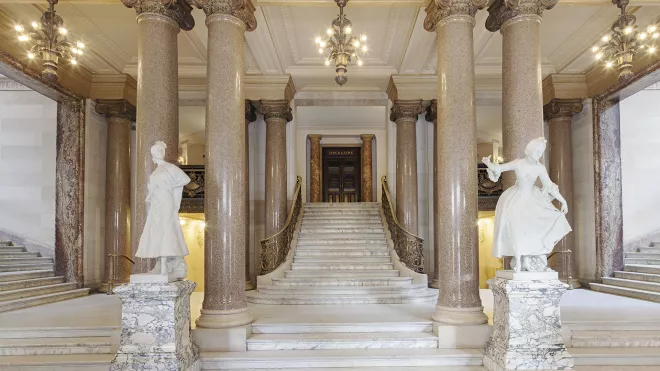
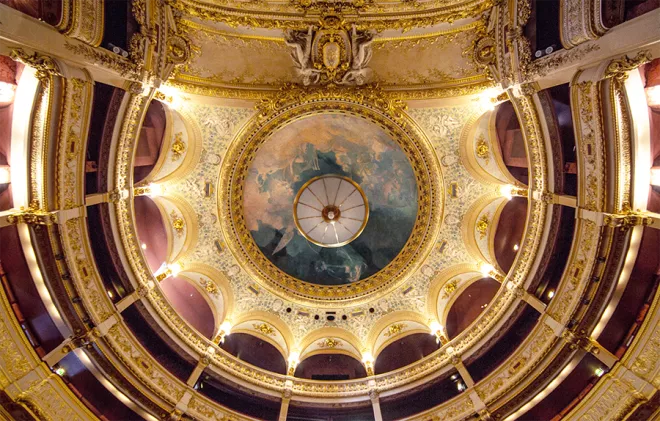
The heritage of the Opéra-Comique is also the Salle Favart itself, listed as a historic monument since 1977. In the entrance hall, the statues of Carmen and Manon welcome the audience. In the auditorium, the ceiling painted by Jean-Joseph Benjamin-Constant depicts a Glorification of Music, in which one can read the names of composers tied to the house’s history.
The theatre’s decoration dates from 1898. It combines paintings, sculptures, mosaics, floral motifs and emblems of comedy. The foyer, restored after more than a year of work under the supervision of the Monuments historiques, bears witness to French art at the end of the 19th century.
The two paintings signed Gervex evoke the birth of French opera (with considerable historical licence) and the fairground origins of the opéra-comique (with a certain realism). The rest of the foyer is painted by Maignan. The balustrades, ornaments and gilded bronze chandeliers are all signed Christofle.
A history marked by fires
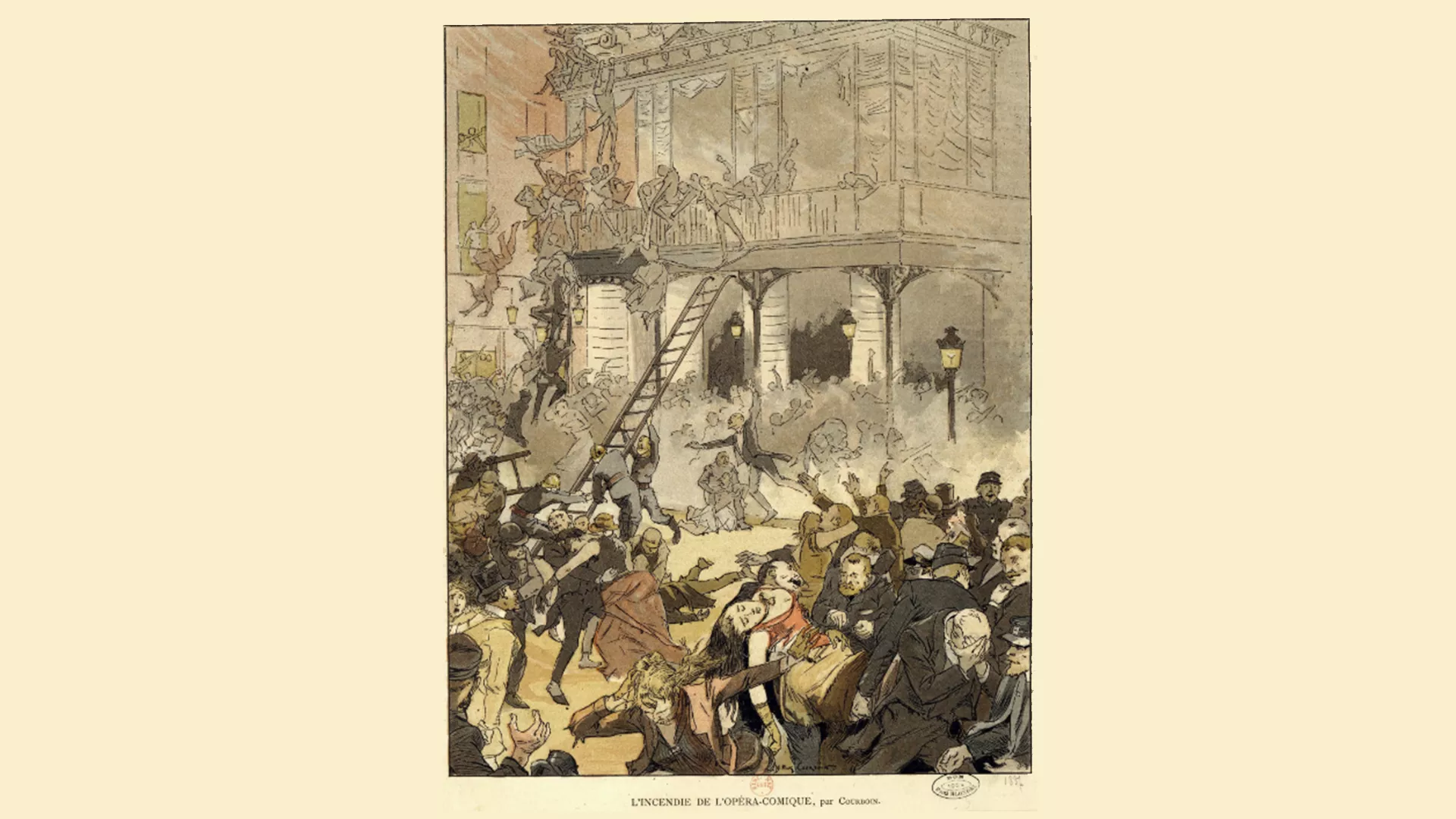
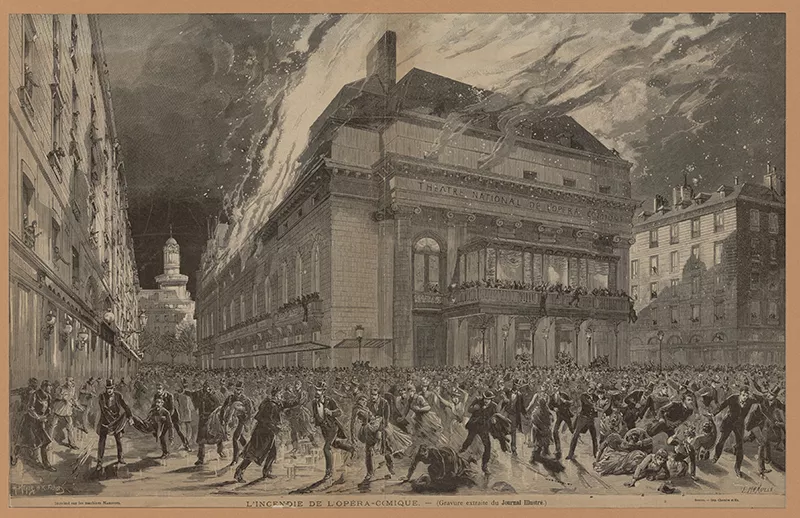
The history of the Opéra-Comique is also the history of its reconstructions. The first Salle Favart burned down in 1838. The second was ravaged by flames on 25 May 1887, during a performance of Mignon by Ambroise Thomas. The event left a lasting mark on the institution and led the State to rebuild the new auditorium.
Upon its reopening in 1898, the Salle Favart implemented the most recent safety recommendations: electricity replaced gas; the iron curtain and the great relief mechanism limited risks; and on the marble staircases, alternating coloured steps allowed ladies in long dresses to evacuate more easily…
Scattered archives, an accessible memory
Over its 311 years of history, the archives of the Opéra-Comique have been scattered. Today, the Opéra-Comique keeps its current and intermediate archives, while its permanent archives are deposited at the Archives nationales. This memory, long fragmented between public collections and private holdings, has been the subject of a project of identification and online publication.
Thanks to the support of patrons and the Ministry of Culture, thousands of images and documents are now available online. The digitised archives can be consulted on Dezède, a database dedicated to the chronology of performances in France.
The Opérathèque
The Opérathèque of the Opéra-Comique makes it possible to find information about the operas of recent seasons, the conductors, the directors, the casts and the production teams. It extends the theatre’s memory work by making productions easier to consult.
Visit the Opéra-Comique
Have you ever stepped through the doors of the Opéra-Comique?
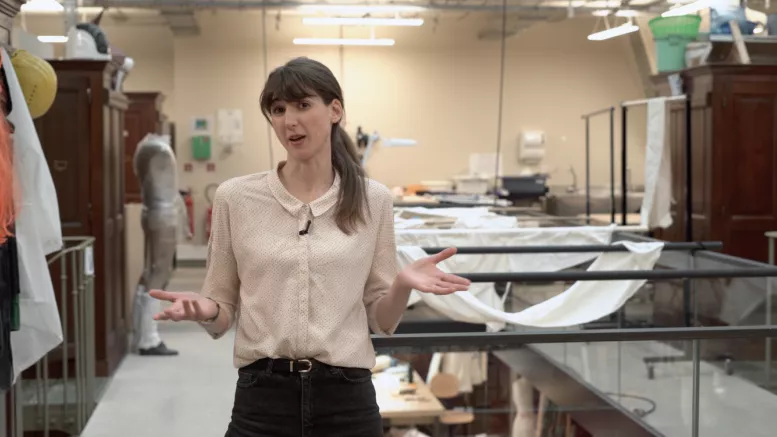
The Salle Favart can also be visited outside of performances. Guided tours, sung tours, family tours and accessible tours offer a way to discover the history of the theatre, its architecture, its decorative scheme and the spaces that make up this place.
Until you come, a filmed tour, a virtual tour and guides allow you to explore the theatre at a distance, in images, in text or in sign language.
À chacun sa visite : en images, texte et langue des signes