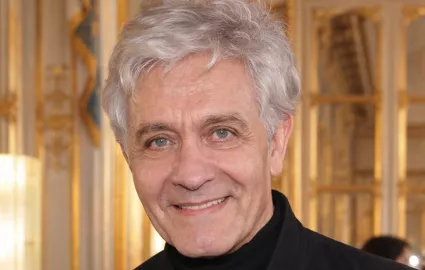
A mezzo-soprano with a vast repertoire, from Baroque lyric tragedy to contemporary creation, Stéphanie d'Oustrac returns to the Academy of Opéra-Comique after her first masterclass in December 2025. An encounter placed under the sign of stage embodiment and French diction.
Cast
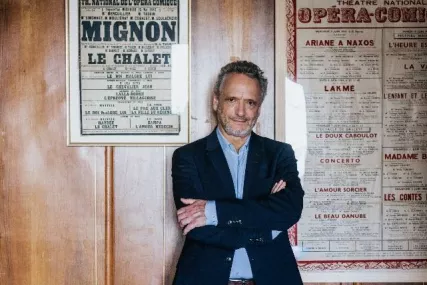
Stéphanie d'Oustrac, with the artists of the Academy of Opéra-Comique • Mathieu Pordoy, director of musical studies
Detailed cast of the 2026-2027 Academy class to come

© Jean-Baptiste Millot
Biography
A French mezzo-soprano born in Rennes in 1974, Stéphanie d'Oustrac is the great-grandniece of Francis Poulenc and of Jacques de La Presle. She sang from childhood in the Maîtrise de Bretagne before entering the Conservatoire National Supérieur de Musique et de Danse de Lyon, where she won First Prize in singing in 1998. William Christie gave her her first tragédienne roles, quickly placing her at the centre of the French Baroque repertoire (Lully's Médée, Purcell's Dido and Aeneas, Armide, Alcina, L'Incoronazione di Poppea).
Her diction and qualities as an interpreter have made her essential in roles such as Carmen, Berlioz's Béatrice et Bénédict, Pelléas et Mélisande, L'Heure espagnole, La Voix humaine, Dialogues des Carmélites, Werther, Les Troyens, Mignon. Carmen, first sung at the Opéra de Lille in 2010, has become one of her signature roles, reprised at Glyndebourne, the Festival d'Aix-en-Provence in Dmitri Tcherniakov's staging, La Monnaie, La Scala and the Opéra national de Paris.
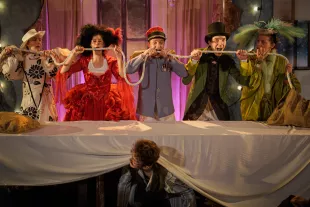
A regular guest of Opéra-Comique, she has sung there Lully's Atys in 2011, Chabrier's L'Étoile, La Périchole in 2022 in the staging by Valérie Lesort and Christian Hecq, and Concepción in Ravel's L'Heure espagnole in 2024 conducted by Louis Langrée. In 2025 she also gave the recital "L'Amour du chant" with Pascal Jourdan and the artists of the Academy. She first worked with the Academy artists in December 2025 in a first masterclass which she extends here.
Program
A regular guest of the house, she has sung Lully's Atys, Offenbach's La Périchole and Ravel's L'Heure espagnole, and regularly gives recitals dedicated to French mélodie.
Detailed program to come
The Academy of Opéra-Comique
A major player in lyric creation for more than three centuries, in 2023 Opéra-Comique opened an Academy dedicated to new generations of performers.
Its mission is to promote the opéra-comique genre and its specific art of interpretation, performed as close as possible to the texts and to stage action. It aspires to be a centre of artistic excellence around French singing and the art of spoken-sung performance. The Academy also aims to identify and support young French-speaking artists by encouraging them to develop fresh perspectives on lyric art and its vitality.
The disciplines of dramaturgy and costume design are also called to join this project.