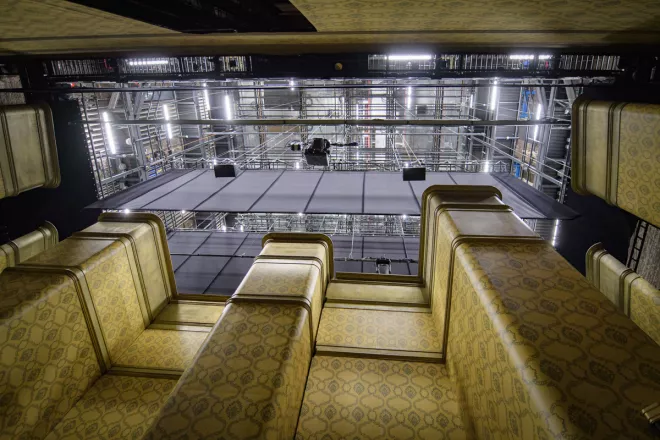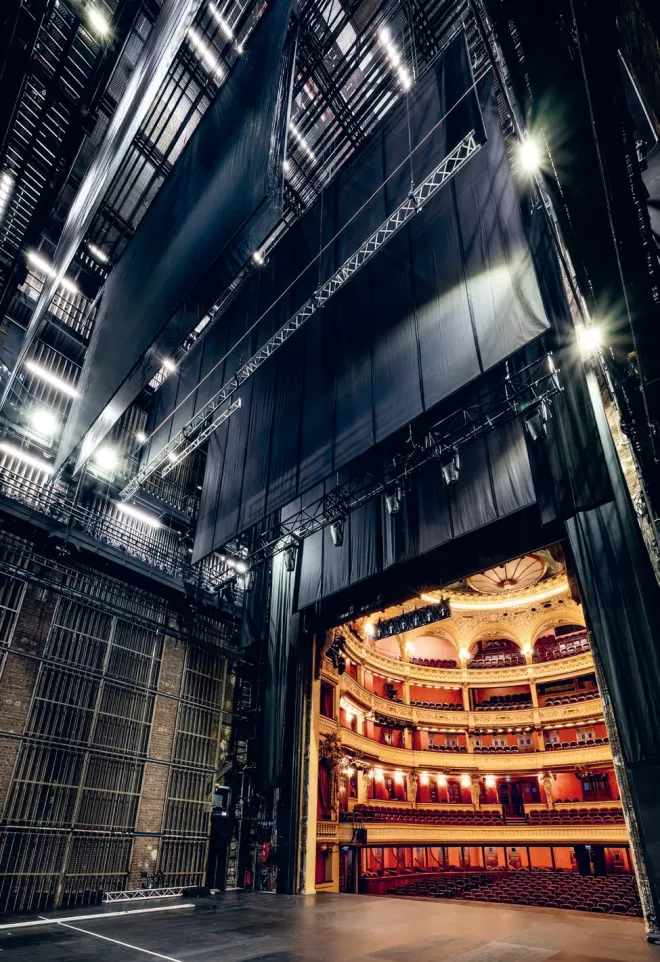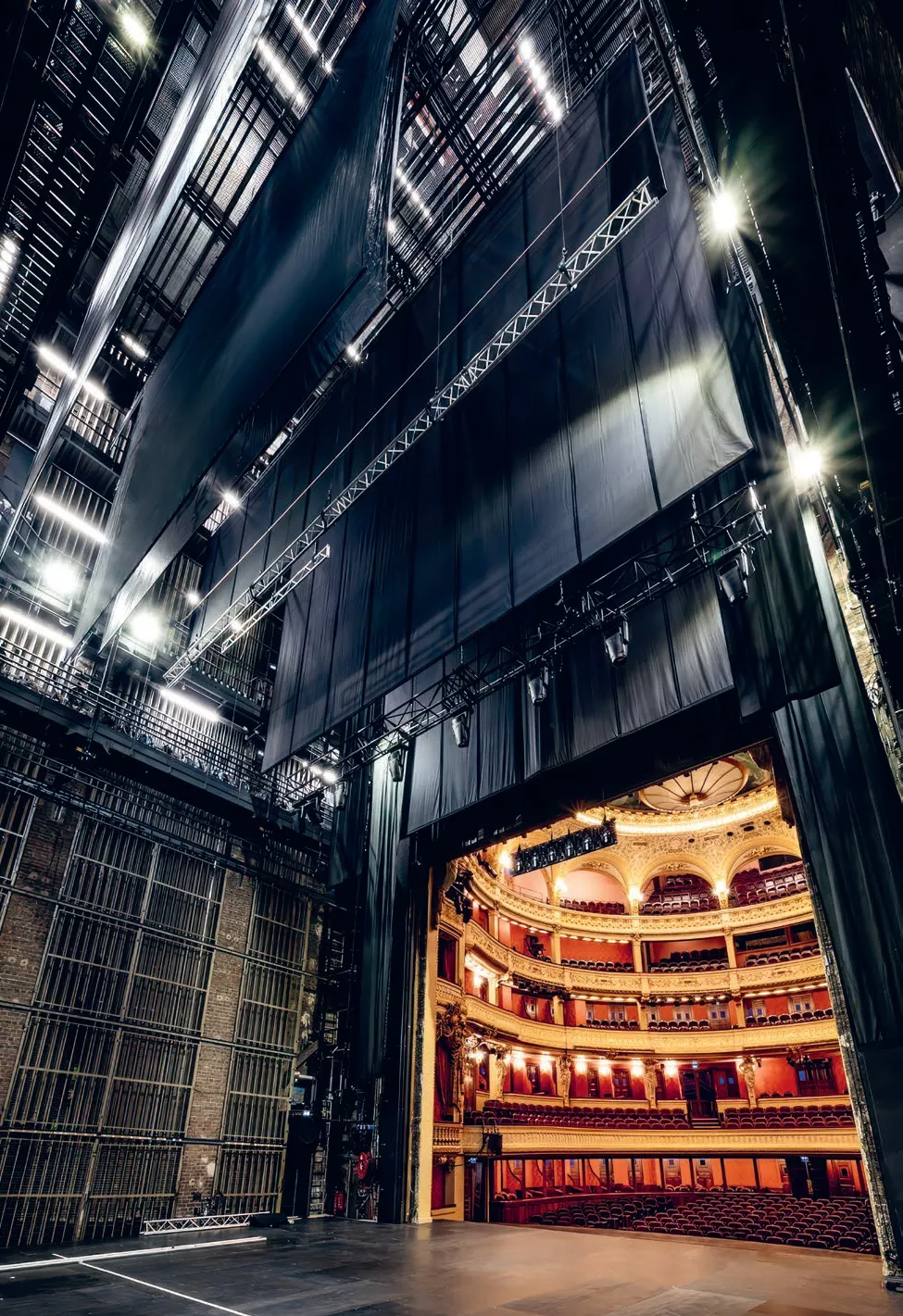
The 2026-2027 season marks a new chapter in this transformation with the modernisation of the stage tower, the true technical heart of the theatre. Hidden from public view yet essential to the magic of performance, this space brings together three interdependent levels: the substage machinery, the stage itself — where sets and technical systems come to life — and the fly tower. It is within this space that technical ingenuity and artistic imagination converge.
The works will first reinforce the structure of the stage in order to restore its full load-bearing capacity and open up new possibilities for staging. A modular structure will be installed beneath the stage, enabling the stage configuration to be tailored to the requirements of each production while opening up new visual possibilities, notably through a system of traps allowing sudden appearances and transformations.
In the fly tower, the historic machinery, still operated through ropes and counterweights, will give way to a motorised system. This development will allow for greater capacity in the lifting and handling of scenery while improving working conditions for the technical teams.
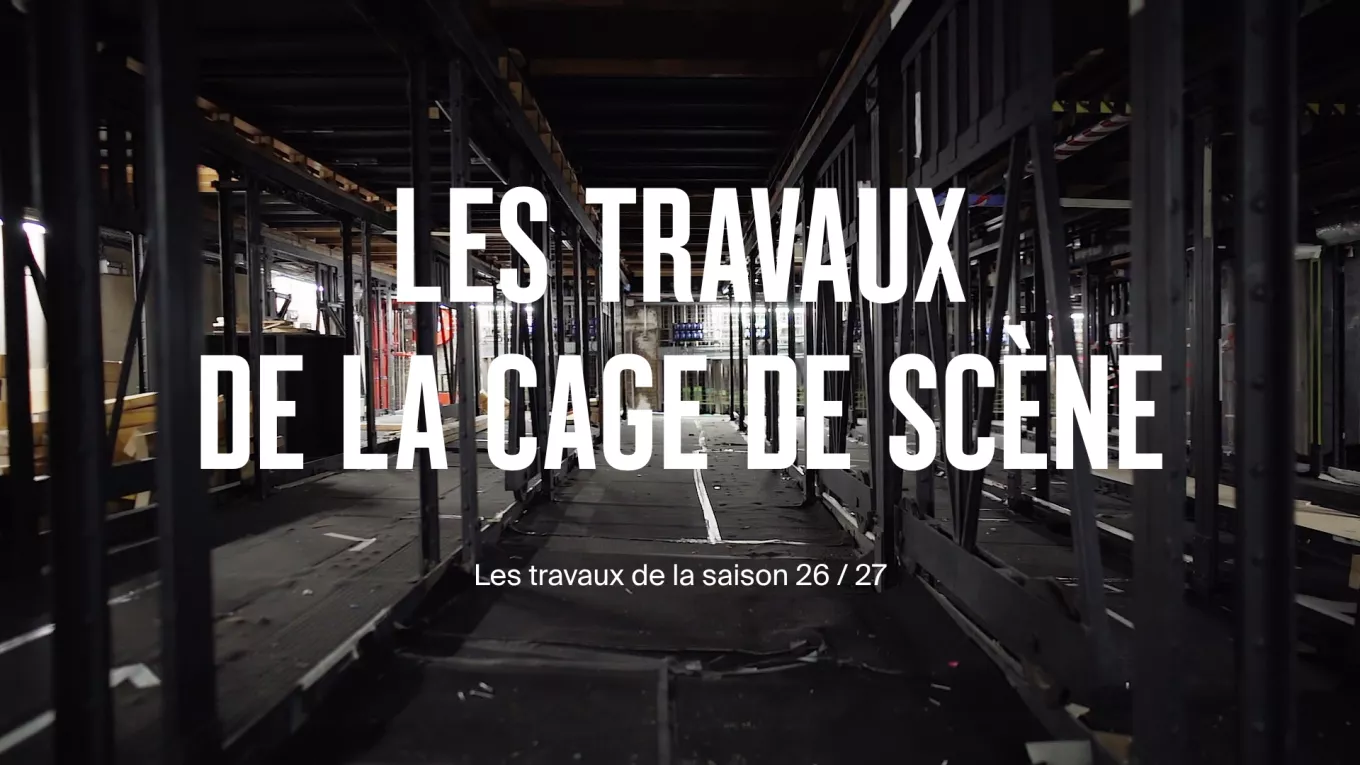
Les grands travaux de la cage de scène
Transcription
Une cage de scène, c'est un outil scénographique pour la réalisation
des productions lyriques au théâtre.
Et les travaux de modernisation qu'on va effectuer sur l'année et la saison à venir
vont concerner trois volumes de la cage de scène :
les dessous de scène, avec la sécurisation du premier niveau de dessous ;
il y aura la fosse d'orchestre, qui sera remise dans son état historique
tout en préservant ses qualités acoustiques ;
et on aura le volume des cintres, la partie haute de la cage de scène,
où l'on va motoriser l'ensemble des équipes et des moteurs ponctuels.
Bonjour, je suis Benoît-Marie Quincy,
je suis le directeur technique du Théâtre national de l'Opéra-Comique.
Je vais vous présenter les travaux de modernisation de la cage de scène
que nous allons vivre en 2026-2027.
On se situe actuellement au premier niveau de dessous de scène.
Et l’objet des travaux qui aura lieu à cet endroit-là répondra à deux objectifs.
Le premier, c'est la sécurisation de la structure qui porte le plateau du théâtre.
Et le deuxième objectif, c'est la modernisation avec une ossature métallique moderne
qui nous permettra une exploitation de l'outil scénographique optimale.
La structure a été fragilisée lors des travaux 2004-2007
et la portance du plateau, aujourd'hui, est de 250 kilos mètre carré.
Le référentiel aujourd'hui étant de 500 kilos mètre carré,
on va atteindre ce niveau-là grâce aux travaux qui seront réalisés la saison prochaine.
Dans les salles à l'italienne, les plateaux étaient effectivement à 4 %
dans la majorité des cas.
C'était pour des notions de perspective et pour mettre en valeur les scénographies.
Et au premier niveau de dessous, on a encore cette pente de 4 %.
Il s'avère qu'en 2004-2007, le choix a été fait de changer la pente du plateau.
Et le compromis trouvé à cette époque a été de réduire cette pente de 4 % à 2,26 %.
C'est pour vous dire qu'on est dans une situation un petit peu délicate,
puisqu'on n'a pas de plancher parallèle à cet endroit-là,
ce qui rend la chose très compliquée puisque, suivant où l'on se situe,
soit très à la face du plateau, soit très au lointain,
on n'a pas les mêmes hauteurs.
Cela nous oblige donc à avoir une adaptabilité des décors
pour passer d'une pente de 2,26 % à une pente à plat.
Je vous propose qu'on aille maintenant vers la fosse d'orchestre,
qui se situe juste derrière moi, à côté.
On se situe au niveau de la fosse d'orchestre,
où les musiciens s'installent pour jouer les opéras.
On est sur la partie fixe, exactement.
La fosse telle qu'on la voit maintenant, elle est dans la configuration proscenium,
c'est-à-dire que les plateformes mobiles sont en haut.
Et lorsque vous assistez à un opéra, les plateformes derrière moi
sont positionnées exactement au même niveau que celui où l’on se trouve aujourd’hui,
pour pouvoir accueillir l'ensemble des musiciens qui officieront sur l’opéra.
Sur l'aspect patrimonial, on va, pendant les travaux,
redonner à cette fosse d'orchestre son aspect historique.
Il y a eu de grandes recherches sur les archives qui ont pu être étudiées,
et on a pu déterminer l'aspect initial.
Donc on va pouvoir, tout en préservant les qualités acoustiques de cette fosse,
lui redonner son claquant d'avant.
Pour cela, on va travailler sur la modification des lambris bois
qui se situent juste derrière moi,
en y apportant des composants permettant le maintien de la qualité acoustique de cette fosse.
Et on va également travailler sur son aspect sanitaire,
qui, aujourd’hui, est très défectueux.
Sur le volet technique, aujourd'hui, on a une fosse d'orchestre composée
de deux plateformes mobiles,
qui se mettent en mouvement par deux mécanismes de motorisation différents.
On a les vis sans fin, qui sont juste ici derrière moi,
et le système Spiralift, qui met en mouvement la plateforme côté salle.
Cette motorisation permet de mettre en mouvement la plateforme mobile
sur laquelle les musiciens s'installent lors d'un opéra.
Et on va profiter de l'homogénéisation de la motorisation pour créer une seule plateforme
plutôt que deux à l'origine.
Le théâtre national de l’Opéra-Comique a déjà réalisé en 2015 - 2016 des grands travaux
dans lesquels l’accessibilité a été un aspect très important.
On va prolonger le geste en rendant cette fosse accessible aux personnes à mobilité réduite,
en remettant le plancher du premier niveau de dessous à plat
et en augmentant l’ouverture de la porte
pour que les personnes en fauteuils roulants ou en mobilité réduite
puissent accéder, malgré tout, à cet espace.
Le fait de rendre cette fosse accessible,
dans un ensemble monument historique,
c’est un vrai challenge auquel on répond
et on sera fier d’y arriver.
Là, on est sur la deuxième passerelle du cintre,
qui est donc le volume haut de la cage de scène.
Là, on est à peu près dix mètres au-dessus du plateau.
Ici, les travaux vont consister au remplacement du système contrebalancé manuel
par un système 100 % motorisé.
Le système contrebalancé consiste à mettre une charge
au niveau du volume de la cage de scène et d’y apposer une contrecharge,
pour venir équilibrer le poids entre l'élément de décor que l’on viendra présenter
et la tige de contrepoids qui viendra contrebalancer la charge.
Aujourd'hui, les équipes contrebalancées du théâtre
ont une capacité maximale d’utilisation à 320 kilos.
Demain, avec la motorisation, on pourra augmenter cette capacité à 500 kilos.
On appelle équipe l'ensemble de la chaîne de levage qu'on a sur un cintre,
c’est-à-dire la porteuse elle-même, les câbles, les poulies,
la tige de contrepoids et la commande qui est en chanvre.
L'avantage d'un système motorisé et à pilotage informatisé,
c'est que vous n'avez plus la partie contrepoids à gérer,
c’est le moteur qui va avoir en gestion
la prise en charge de l’élément accroché sur l’équipe.
En plus du remplacement du système contrebalancé,
on va y apporter une amélioration avec des moteurs ponctuels
qui, comme son nom l’indique,
va nous permettre de pouvoir, ponctuellement, lever une charge
à des endroits bien définis de la cage de scène,
en travail commun avec le scénographe.
In this respect, the spirit of the project remains faithful to that of the architect Louis Bernier: placing the most advanced technologies at the service of artistic creation.
This modernisation campaign also provides an opportunity to rethink several emblematic spaces within the theatre. The orchestra pit is receiving particular attention: its decorative scheme will be restored in the spirit of the designs conceived at the end of the nineteenth century, thereby completing the architectural harmony of the auditorium. Access to the pit will also be redesigned in order to improve conditions for musicians and ensure accessibility for people with reduced mobility.
This transformation pursues a dual ambition: to preserve the history of the theatre while preparing its future. By restoring the stage's full technical capacities and modernising its equipment, the Opéra-Comique is equipping itself with a stage apparatus capable of supporting the widest range of creative forms, today and for decades to come.